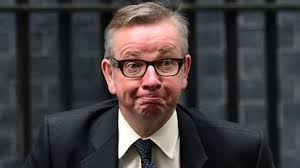
The lips remain out of control. The eyes fixed like tombstones. In many ways, Michael Gove is a different man to the 2014 model though, a different predator – less goofy and slappable, more polished and precise. The glasses help, as well as the greying hair. Newly-divorced, perhaps more stoical, he is a white collar Artful Dodger, a man that never quite embraced childhood.
A decade ago, Glen Newey asked, “Does Michael Gove exist?” as if bamboozled by such a presence, “that effortlessly gormless mug … presumably computer-generated”. Lots of people have been cruel. Many have forgotten he was adopted at just four months old, surrendering his original name, Graeme Andrew Logan, and a good chunk of his identity.
Sometimes it feels as if he’s permanently pinned to school railings, taking blows to the guts, coming up for air only to see the uncomprehending and merciless faces of society delighted at their target. Except, Gove can dish it out. He can give it. Intimidation seems to bounce off him or vaporize as it hits his Oxbridge chest.
“Maybe the only man you could meet who always remembers his manners, even during a bloodbath,” John Pienaar said in 2016. What to make of that? Never losing his rag. Never forgetting to be dispassionate. Facing the opposition with unblinking surety. Morph-like and expressionless in his plasticine garb.
Given that Gove is such a mosaic – born 1967 (star sign Virgo), Labour Party member 1983, read English at Oxford 1985-88 while belatedly becoming a Tory, deemed “insufficiently Conservative” when applying for a job post-university, enamoured by Rupert Murdoch, part of Radio 4’s Moral Maze panel – his lack of a political compass at times is understandable and engrossing.
It perhaps best explains him keeping his cool, because essentially he is a wandering red with half a blue blood transfusion; tubes still trailing from him, his head and demeanour part Aberdeen, Edinburgh, Notting Hill and Westminster. His manners can be both disarming and maddening. His policy ideas rump and ridiculous, or expedited and effective.
Leader writer for The Times from 1996, made Secretary of State for Education in 2010, SoS for Justice in 2015, Vote Leave co-convenor in 2016, SoS for Environment, Food & Rural Affairs in 2017, and SoS for Levelling Up, Housing & Communities in 2021, simplifies his ascent, but also loosely hints at his wild ride and stickability. To some Gove is the luckiest bastard alive. To others he is symptomatic of a broken political system – Grant Shapps with a more dangerous brain; oddball squared.
And yet there is sense in those Gove electrodes. If we ignore his nadir in 2013/14 when he busted up an entire sector of the British economy – education: the fragmentation of the school system and “13% of full time teachers at free schools … now unqualified,” according to The Conversation/Guardian.
As justice secretary, he removed the limit of “12 books per cell” in prisons and scrapped a Ministry of Justice bid for a Saudi prison authorities’ contract. As environment secretary, he played a significant role in the banning of microbeads (plastics), thus mitigating the damage to marine life. He also banned the sale of new petrol and diesel-powered cars from 2040 (now 2035) to reduce air pollution, plus bee-harming pesticides including neonicotinoids. And as levelling up secretary, he has opposed fracking, been resistant to new skyscrapers such as the “visually intrusive” Tulip, and purged Section 21 notices which gave landlords the right to evict tenants without a specific reason.
Effective politician and minister in the wrong body, with the wrong disposition? Gove is seemingly not so much an enigma as a victim of the brutal British need for amiability and likeableness, even if built from slime. Tony Blair. David Cameron. Boris Johnson. Strains of that Death of a Salesman/Willy Loman obsession with being well-liked. Presentation. A smidgen or hint of the bounder (more latitude given if humorous).
Mary Ann Sieghart wrote, in 2018, “Just the mention of his name on comedy shows elicits guffaws and groans”. Why? Because he does not have a settled face. Because he speaks in a peculiar way. Because he does not possess (however misguided) that British ‘quality’, infatuation or fixation we call character. Gove is an anti-hero with anti-charisma. He is inordinately polite – quite a feat given the UK’s dip in manners post-Thatcher. Curiously though, he gets things done. He has courage. He puts himself in the firing line – be it television interviews, interactions with officials and civil servants, discussions and debates with ideological adversaries, House of Commons’ despatch box altercations, or random presentations.
Gove readily accepts that he is different. He said as much when first running for the Tory leadership in 2016: “I have to say, I never thought I’d be in this position. I did not want it … I did almost everything I could not to be a candidate for the leadership of this party. I was so very reluctant because I know my limitations. Whatever charisma is, I don’t have it. Whatever glamour may be, I don’t think anyone could ever associate me with it.”
Refreshing, in a way, that he isn’t the usual political psychopath, reeking of ambition, foul to touch or engage with. Indeed, Gove is a harbinger of sorts. “I came to realise … for all Boris’s formidable talents, he was not the right person for that task [of party leader].” Plenty of detractors for this ‘stabbing in the back’, but many have gone the way of the knife, deservedly so. And 2019-22 brought what Gove had predicted via his tippexed or concealed words: mess and mendaciousness.
Gove, in his straightforwardness, his candidness, his unequivocal turkey shoot, his thinking things through, breaks with British convention. Some call this being a snake, disloyal, terrible behaviour leading to froideur. But maybe that convention is the Old Etonian way – chums before reality, something which Gove has always been keen to disenfranchise.
In the race to replace Johnson in 2022, Gove endorsed Kemi Badenoch, whom he described as “brave, principled, brilliant and kind”. The party machinery, given its preference for the frenetic Liz Truss (who lasted 49 days) and current incumbent Rishi Sunak via the back door, may finally latch on to the fact that intelligence and agility matter.
Once Sunak loses the 2024 General Election – as everyone expects – Badenoch and Penny Mordaunt step forward as the only credible candidates in a field consisting of the disastrous Suella Braverman. Does Gove run again following his bronze medals in 2016 and 2019 and his once explicit words stating that he’s “constitutionally incapable of it”?
Michael Portillo considered Gove a “serious contender” back in 2012. And as a revolutionary with “posters of Lenin, Martin Luther King [Jr] and Malcolm X” perhaps still adorning his office walls, Gove is certainly a unique beast. But would colleagues, party members and – eventually – the British public back him in sufficient numbers? The former yes if they want a full shampooing of the rodent-infected carpet left by Johnson. Party members – unlikely, given that most still believe Britain to be a large scale Downton Abbey. The British public – no, because Gove is neither cool, nor a tagline such as “Strong and Stable”.
That is to his credit though. Hated by the left. Comfortable in his uncomfortableness. Unafraid to jaunt around the city during protests. Michael Gove is the last of a dying breed, has a cache of “legendary politeness” and still sees “a gold standard for the wealthy and a creaking, outdated” country for the rest. Quite why the Tories covet him and continually resuscitate him as part of their cabinet is often hard to figure out. Reliability. Inventiveness. Pleasantness. Reminders, possibly, of what they should never be.
Article (c) Jeff Weston, author of Wagenknecht (All Men crack up at forty)
 Thinkwell Books, UK